
Hi friend,
I first spoke to Dr. Eric Verdin in early 2025.
He told me then that we were right at the beginning of a hockey curve in longevity science. A year later sitting across from him again, it feels like we are already shooting up that curve.
Eric is a physician-scientist and CEO of the Buck Institute for Research on Aging. He has been in this field for 30 years. He is measured, evidence-driven, and one of the few people in this space who will tell you directly when something is nonsense even if it is popular.
This conversation is one of the most grounding and genuinely useful episodes we have recorded.
Podcast Insights
The data does not say what you think it says
Dr. Eric Verdin does not use the word revolution lightly.
His argument is straightforward. For most of medical history, we have treated diseases one by one. What longevity science is beginning to do is treat aging itself, the underlying process that makes all of those diseases possible in the first place. If you slow aging, you delay or prevent everything downstream.
The areas he is most excited about are not single silver bullets. Eric is clear that no one who understands aging believes there is one magical solution. What he sees is an array of directions moving simultaneously. AI processing data sets that human brains cannot handle. GLP-1 drugs showing protective effects on the heart, kidney, and brain that nobody anticipated. Partial reprogramming offering the possibility of resetting cells to a younger state without turning them back into stem cells entirely.
He is also direct about what the science does not support. NAD IV therapy, which he calls nonsense. Peptides bought from unregulated sources. Supplements stacked on top of a poor lifestyle.
His five evidence-based interventions for brain health, and why 2030 is the year he believes everything changes, are in the full episode.


In this episode you will learn:
Why aging is now being treated as a biological process not an inevitability
What partial reprogramming is and what it could mean for human health
Why NAD IV therapy does not work the way most people think it does
The five things science actually supports for protecting your brain
Why 2030 is the most important year in the history of longevity research
Simple practice
Move for twenty minutes twice today
Eric was direct. Exercise is the best anti-aging medicine available right now.
His specification matters. It is not necessarily sport. It is being in motion. Zone two walking, strength training, high intensity intervals, balance work. All of it contributes and all of it has evidence behind it.
Today, take two twenty-minute walks. One in the morning, one in the evening. That is it. No gym required. No equipment. Just movement.
Why: Eric says this alone will do more for your longevity than any supplement stack currently available.
Post of the week
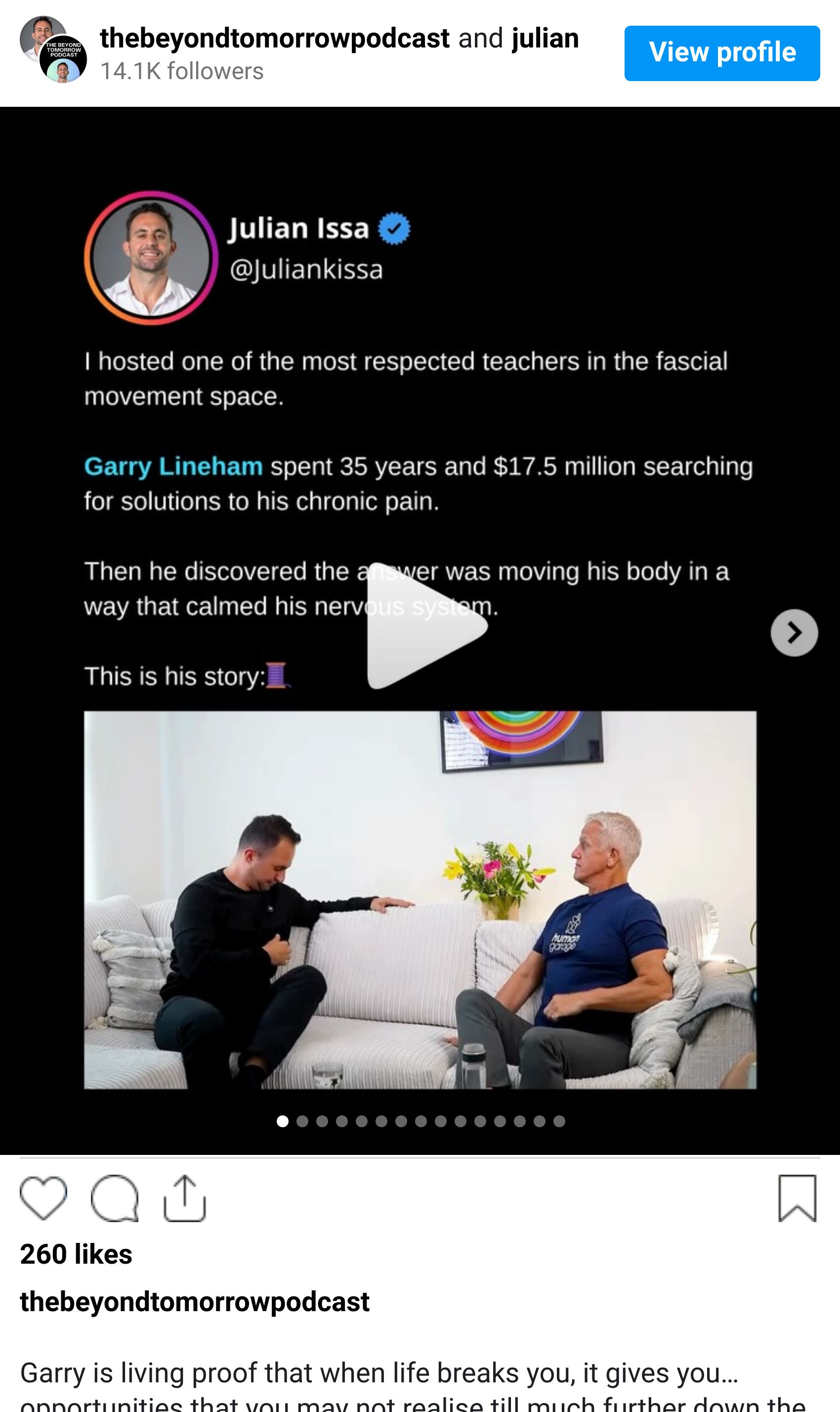
$17.5 million, 35 years, and his own clinic treating the LA Lakers and the US Olympic team; Garry Lineham was still waking up in pain every single day. It took a pandemic and a 15-minute morning routine to end it. Swipe through if you missed it 👇
Every time a new life begins, aging resets to zero.
Dr. Eric Verdin has spent 30 years trying to understand how that happens. The work he and his colleagues are doing at the Buck Institute is part of the reason 2030 is going to be a different kind of year.
The line is always going up.
Julian x
